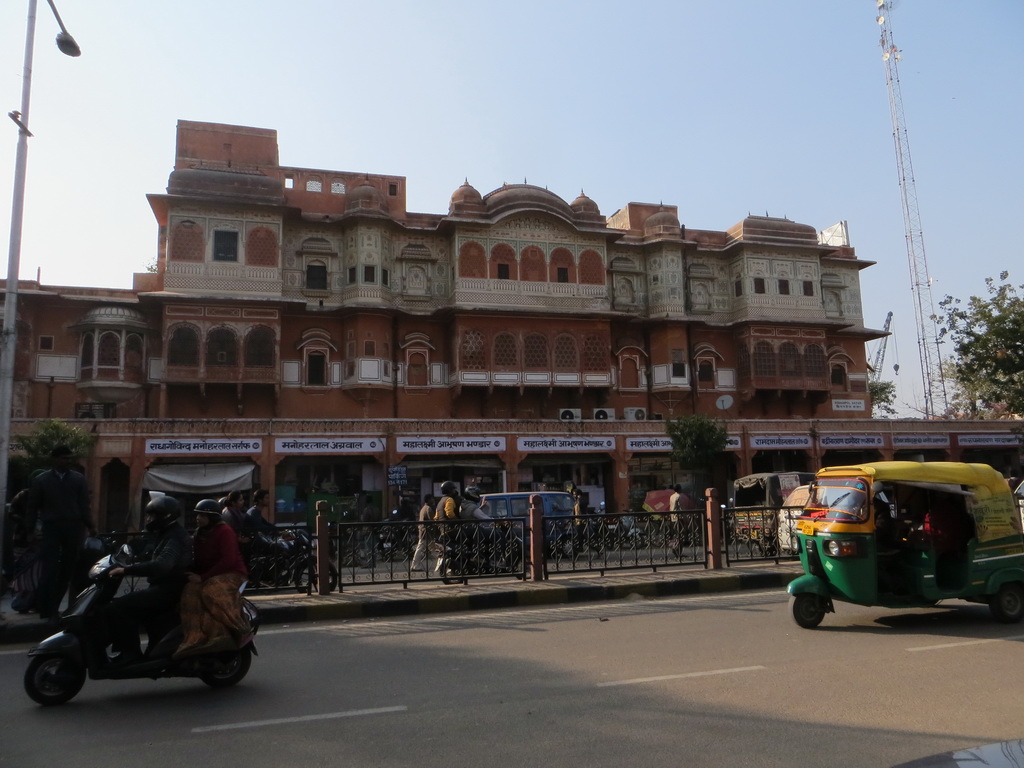
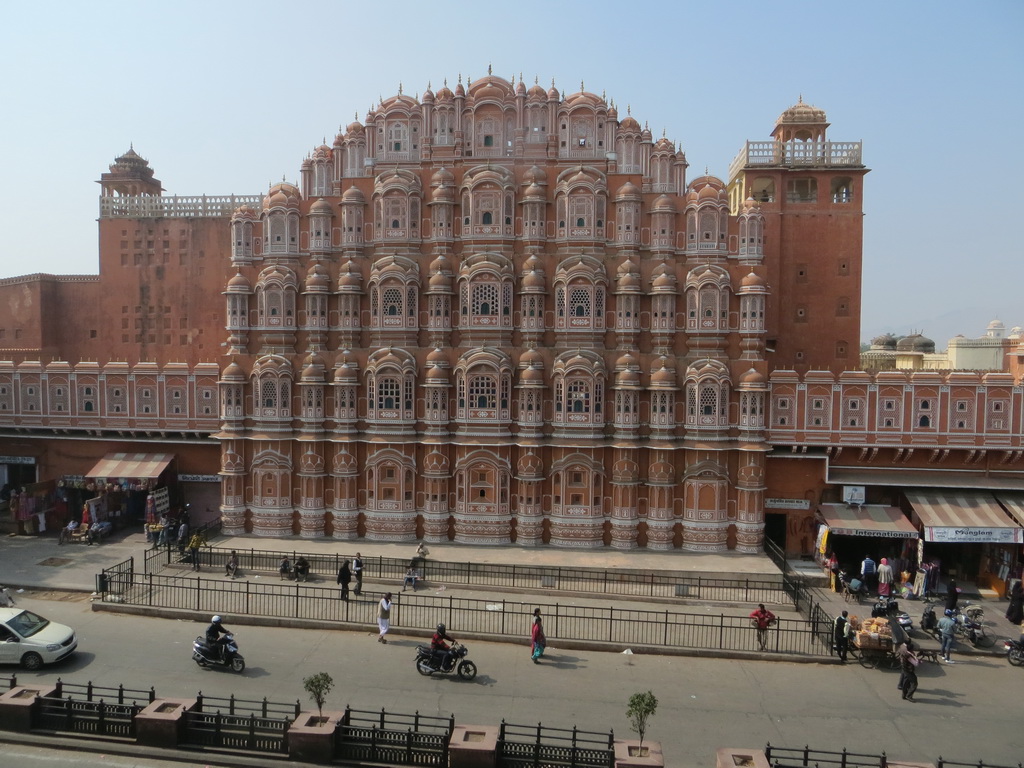
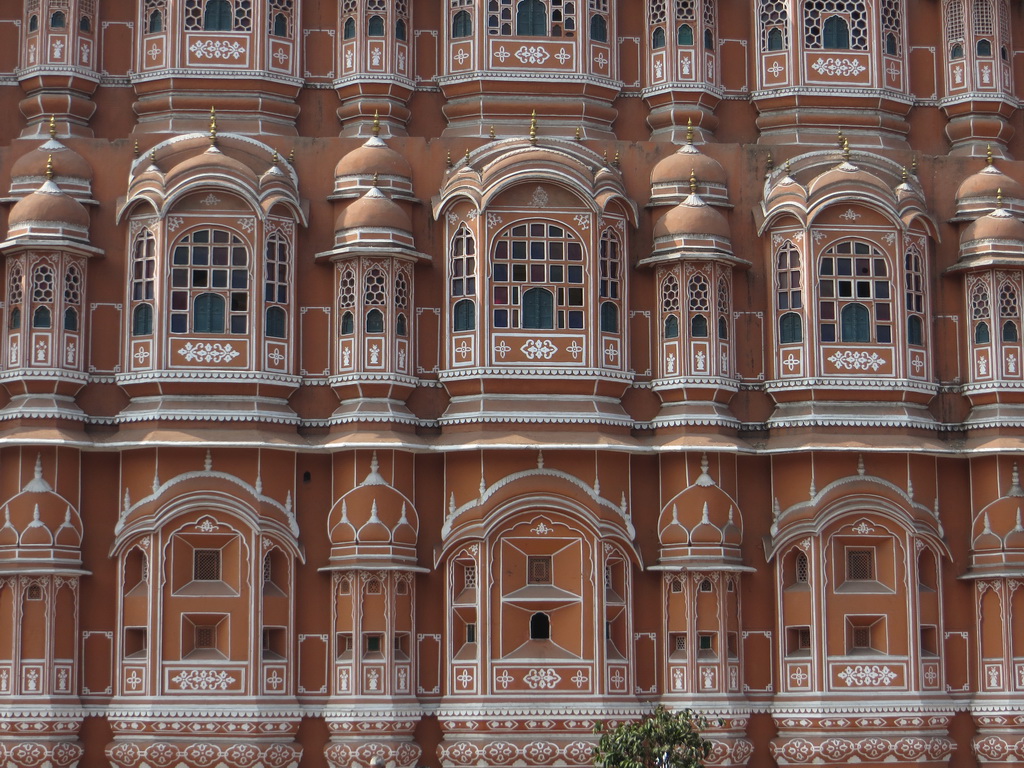
Besides, in Jaipur they won’t let you just stand around and admire the beauty of something. As soon as we stopped opposite Hawa Mahal, an Indian man came up to us right away with the usual questions about where we were from and what our names were… I had read about the little staircase located between the shops right opposite Hawa Mahal. A stone staircase leads up to a rooftop with a good view of the building. This Indian man also offered to take us up there. We climbed up, and the Indian followed us. The view really was good. But it was impossible to just stand there and enjoy it because of the Indian, who didn’t stop talking for a second. After taking a couple of photos, we were getting ready to leave, and then the Indian persistently invited us into his little shop on that very rooftop — we ran away…
We went on to the City Palace. Three beautiful arches lead to the palace. Entrance to the palace is not free, 400 rupees per person, not bad…
Right there we hear Russian being spoken — we turn around, and surrounded by women stands a guy with a big belly, wearing a black T-shirt with a portrait of Putin. It’s disgusting to look at.
We decide not to go into the palace; it’s too expensive, and besides, I don’t really remember what there is to see there.
After wandering back and forth around the palace a bit, we got tired of fending off pushy tuk-tuk drivers who were trying to take us here and there. In the end, we decided to ride in one of those hybrid cycle rickshaws, sort of a bicycle, but with a little motor. The driver seemed more or less pleasant and promised to show us around the city for 40 rupees. We got in and set off. He tells us that Jaipur has many different factories: jewelry factories, textile factories, factories making cashmere items. We still didn’t quite understand where he was going with this. Then he stopped opposite one of the buildings and said:
-This is a very good silver jewelry factory, go in and have a look
-We’re not really interested in that
-No, no, it’s very interesting inside — go on, it’s free
All right, we went in. As soon as we entered the small room, a salesman immediately ran up to us and offered to take us around the factory and show us how they make jewelry. It all felt kind of disgusting, the way they kept trying to push something on you. We came out and drove on. The man took us through some strange backstreets, and we arrived at another factory — this time a textile one. Same story: “No, no, go in, have a look, it’s very interesting.”
We explained that we hadn’t come to buy anything, but to see the city, and that we weren’t going to purchase anything — so we drove on. The man seemed to understand, but then he brought us to yet another building of something else. I was already confused about which number it was and what exactly they were trying to sell us there. The driver kept saying that everything here was very cheap, unlike the bazaars. Volchiy and I thought otherwise — what if, on the contrary, the prices here were inflated.
After driving around like this for about an hour and not really seeing anything, the driver dropped us off on one of the central streets opposite a supposedly free antique museum. After paying 40 rupees, we decided to take a look inside. The museum turned out to be a little hovel with shelves piled high with antique model cars, old photographs, dishes, and jewelry dumped into boxes — all covered in a thick layer of dust. The museum owner first spoke enthusiastically about his exhibits, and when we were getting ready to leave, he persistently tried to lure us into his shop next door — “Just have a look, I have excellent trousers for you, madam.” We barely managed to escape from the museum owner too.
We went on wandering around the city. I kept being glad that we had left Jaipur “for later” — in a city like this, it’s very hard to fall in love with India. Still, by midday I had more or less gotten used to the city’s mercantile atmosphere.