Morocco, 2018

Day 22: October 22

Dades - Imilchil

Morocco, 2018

Itinerary

Today is the first cloudy day in Morocco. Just think, three weeks of endless sun. Yesterday I told Volchiy that I had already started to believe that it never rains in Morocco. And today the whole sky is covered with clouds. The forecasts promise only clouds, no rain. And I really want to believe that because ahead of us is the road through the Dades Canyon.

I read a lot about the road through the Dades Canyon. They say that it is paved only halfway, and then there are 50 km of dirt road through the mountains. What condition is that dirt road in?.. Few people write anything specific, which is understandable — I think a lot depends on the weather. Everyone agrees that it is just right for jeeps, but for an ordinary car it is questionable. I found a couple of reviews about how Europeans drove there in their caravans. Volchiy agrees to try.

They say this road is included in various top lists of the scariest roads in the world. I don’t know about the whole world, but in my personal top it definitely takes the top spots…

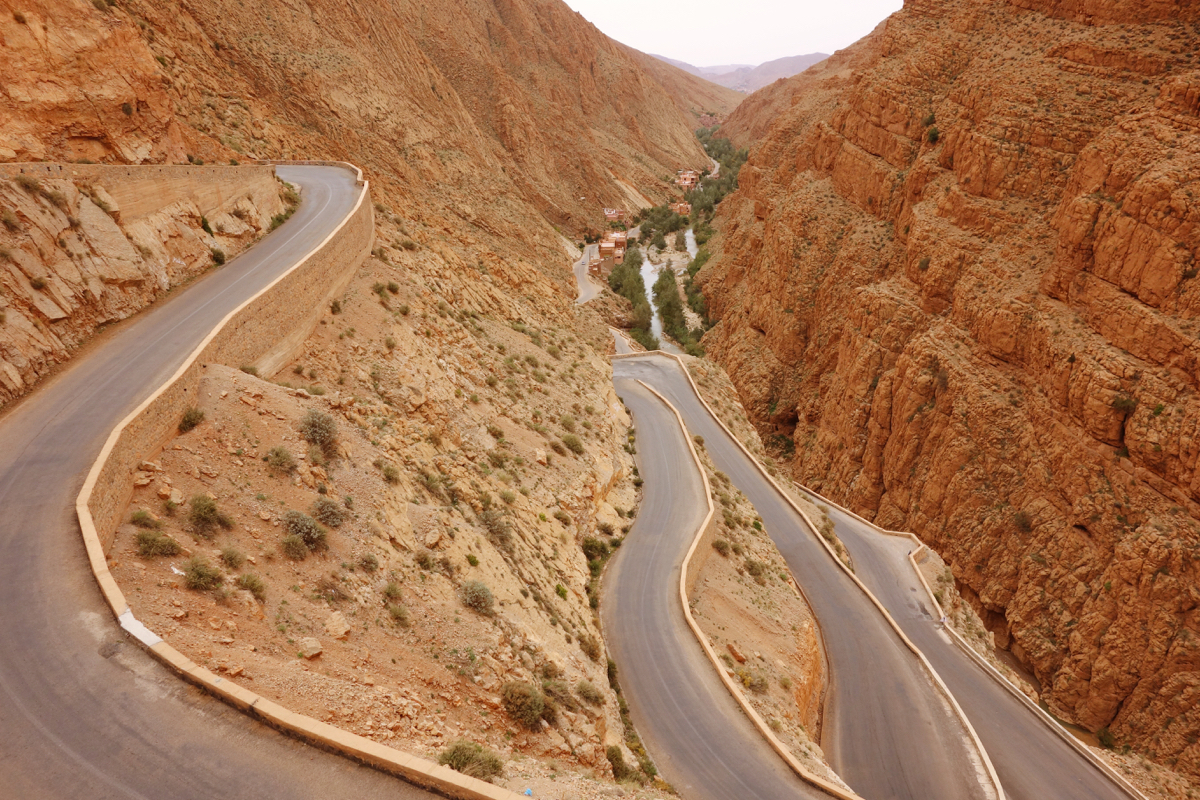
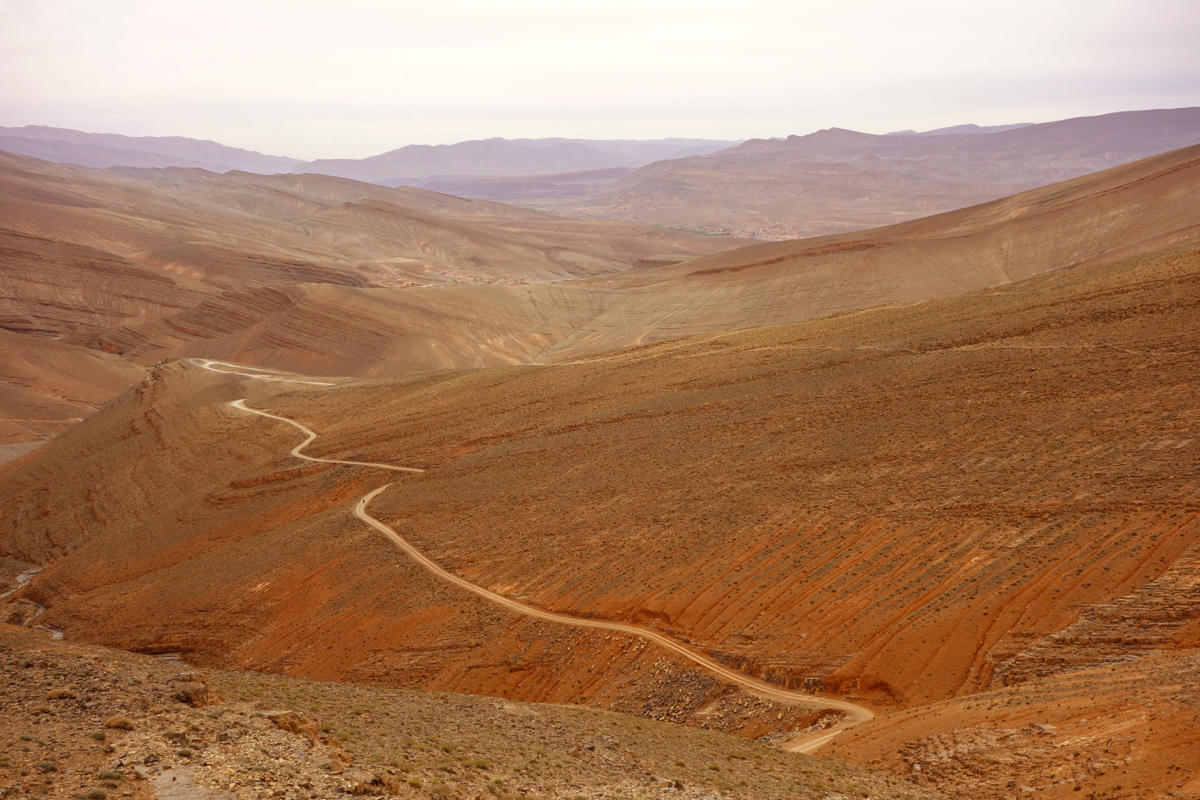
Soon after the start of our journey, the road became very scenic. The pavement is still there.

Road through the Dades Canyon. Mountain switchbacks

Road through the Dades Canyon. Mountain switchbacks

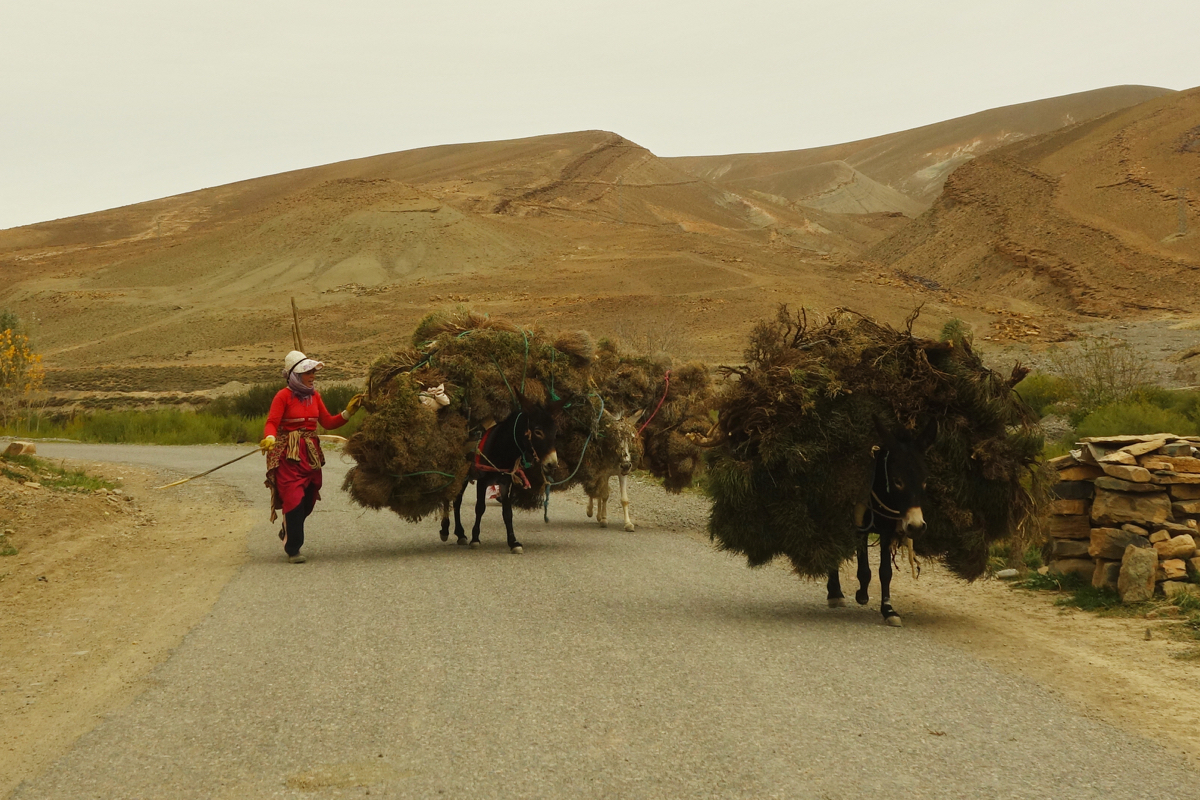
Soon the asphalt deteriorated a little, wild villages began where children with wide-open eyes shouted “Bun jour!” (good day) at us, women led donkeys loaded with firewood, and people lived in very simple huts.

Donkeys carrying firewood

Donkeys carrying firewood

We would drive along the bottom of the canyon beside the river, then climb up to the top.

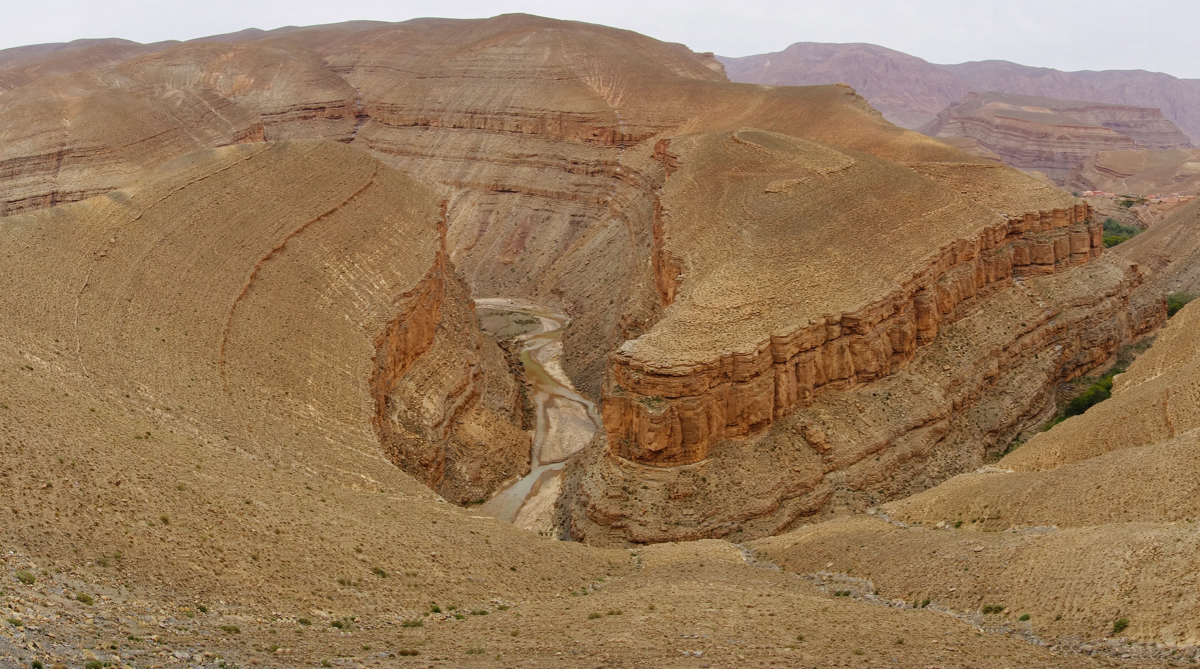
The river has astonishingly cut through the rocks

The river has astonishingly cut through the rocks

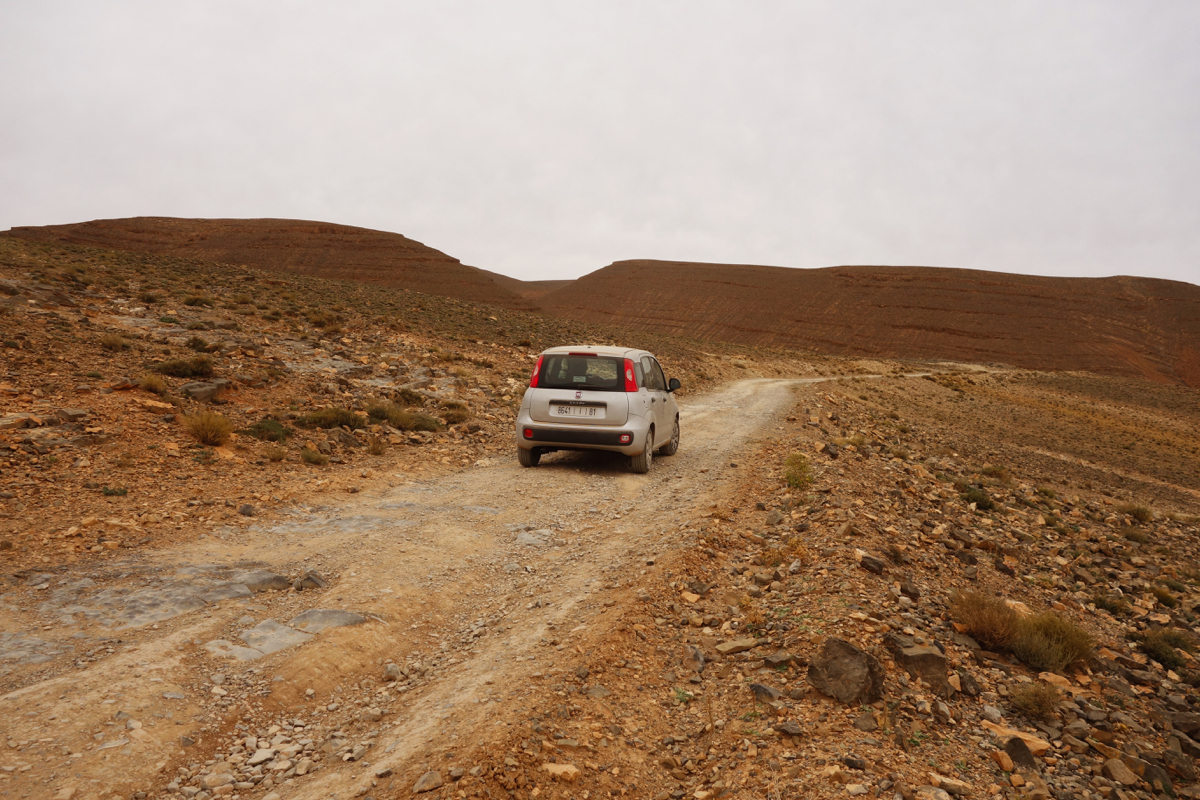
And finally the road turned into a dirt track. There were 44 km left to the fork, where, as I had hoped, there should have been asphalt.

At first it was very scary. Then we got a little used to it. We are driving very slowly - 10-15 km/h. It feels like we are alone in the whole world. Sometimes this feeling is broken by herds of goats and their herders. They wave their hands cheerfully and ask for cigarettes.

Start of the dirt road

Start of the dirt road

The first vehicle we came across was an old German Ford converted into a caravan, with a young couple inside. We spotted them from afar. We saw that they had slowed down—probably to let us pass. The road here is very narrow, just wide enough for one car. It runs along the mountainside, with a drop-off on the other side. There are few places to pass each other.

Part of the road is already behind us

Part of the road is already behind us

We pass the caravan, thank them for waiting for us, and keep going. The fact that the caravan made it all the way here is a little encouraging. But it has much more ground clearance than our Panda... So there’s no reason to celebrate just yet.

We continue on our way. Volchiy often jumps out of the car and removes large rocks from the road. Meanwhile, I take photos. There’s beauty all around us, mountains. It’s just a pity that it’s overcast. A little farther on, we meet two motorcyclists on dirt bikes. And then three more on BMW motorcycles.

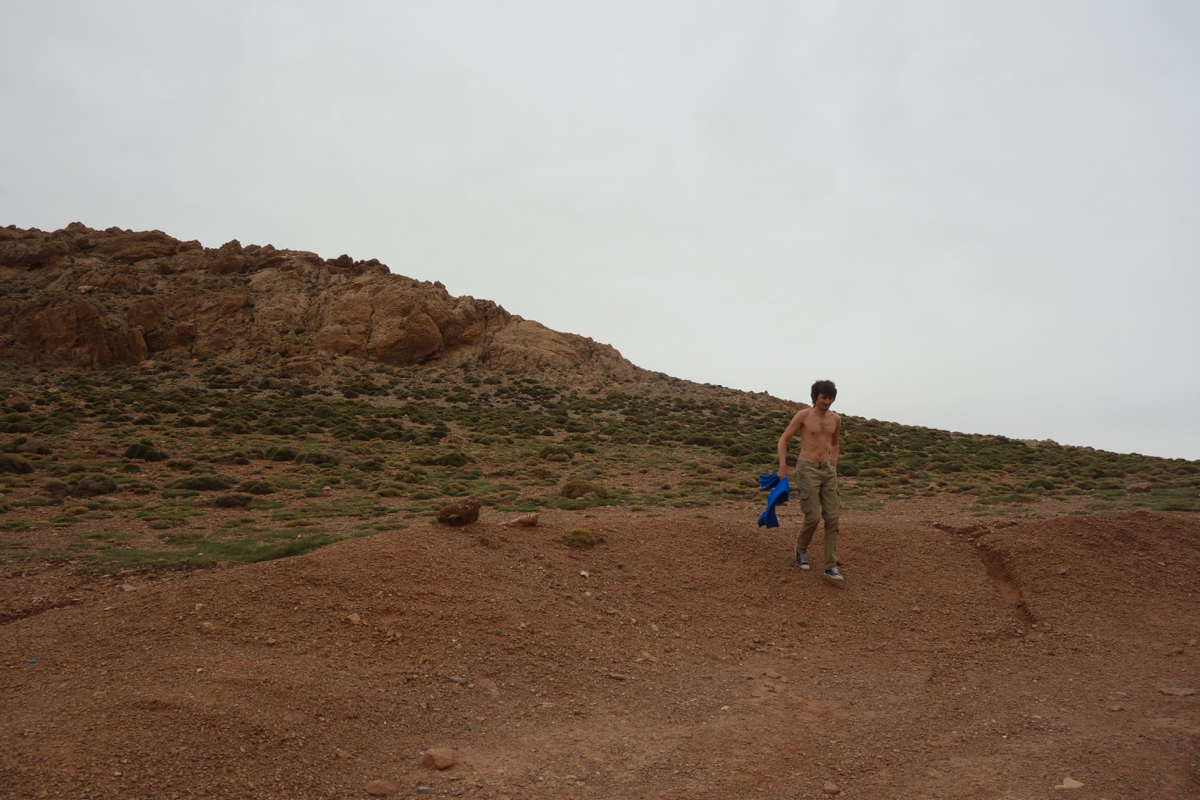
At last, we reach the pass. The road has climbed to an altitude of 2,900 meters above sea level! It’s hard to believe. It’s freezing here and the wind is strong! We get out for a bit of fresh air. But I immediately hide back in the warm car, while Volchiy climbs up the nearest little peak.

The peak that Volchiy climbed. Volchiy is being tempered

The peak that Volchiy climbed. Volchiy is being tempered

After the pass, it became psychologically easier. Even though we understood that anything could still lie ahead. Along the way we meet the second car in all this time — an old Jeep with Moroccan plates, loaded to the brim with some kind of goods, and mattresses on the roof. We descend into the valley. It’s getting warmer before our eyes. Sheep are grazing.

There are 10 km left to the fork. We’ve already been driving for 4 hours. And then a line of Jeeps comes toward us, all identical; we thought it must be some kind of Jeep tour. In the first one sits a Moroccan man, in the others — people who look European. We let them pass. The last Jeep stops near us. At the wheel and in the navigator’s seat are middle-aged men. They roll down the window and look at us intently, as if they can’t believe their eyes. And then the one in the navigator’s seat says, “Guys, that road there… it’s really difficult. I honestly don’t even know how you’re going to get through. Be careful.”
We exchanged glances. And why did they tell us that? Quite encouraging, indeed.

We keep driving, and the road gets closer and closer to the river. Good thing it’s gravel. Then the road starts winding through the river, and that’s when it becomes truly scary. I don’t know, maybe the spell of that navigator from the Jeep had an effect; maybe if we had been unaware, it wouldn’t have been so frightening. The thought that we might have to turn back is simply unbearable…

We had long noticed that usually there are no photos from the scariest places. And this case was no exception. I was sitting on pins and needles and was afraid to move even a little, and in the most dangerous spots I squeezed my eyes shut.

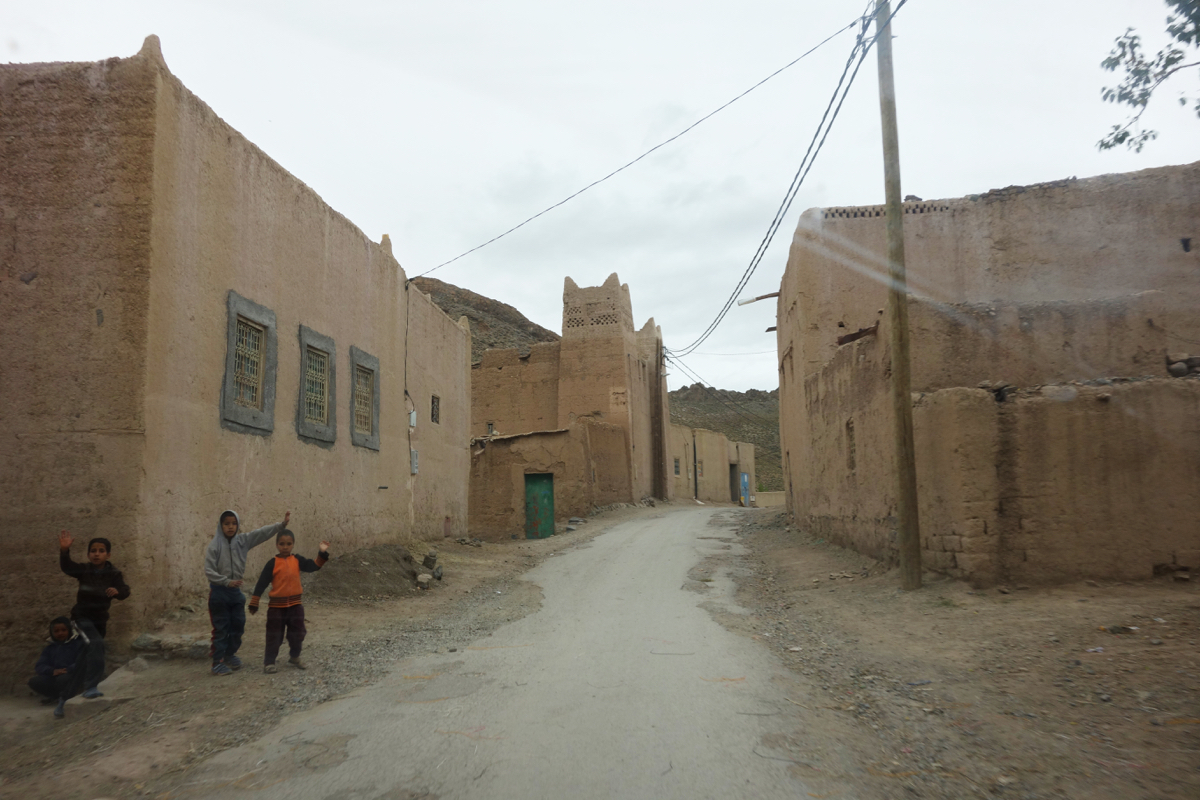
We crossed one ford after another. There were 6 km left to the fork, 5 km, 4 km… and hooray — we reached the asphalt. At first we drove into a wild, wild village where crowds of children began throwing themselves at the car, shouting, “One dirham, one dirham.” And under the mud-brick dwellings, right on the ground, as if in some kind of trance, men in djellabas with pointed hoods were sitting.

Children preparing for an attack

Children preparing for an attack

The road became paved, but it still wasn’t possible to drive fast on it because the surface was very worn out. But we breathed a sigh of relief… Hooray, we finally did it!

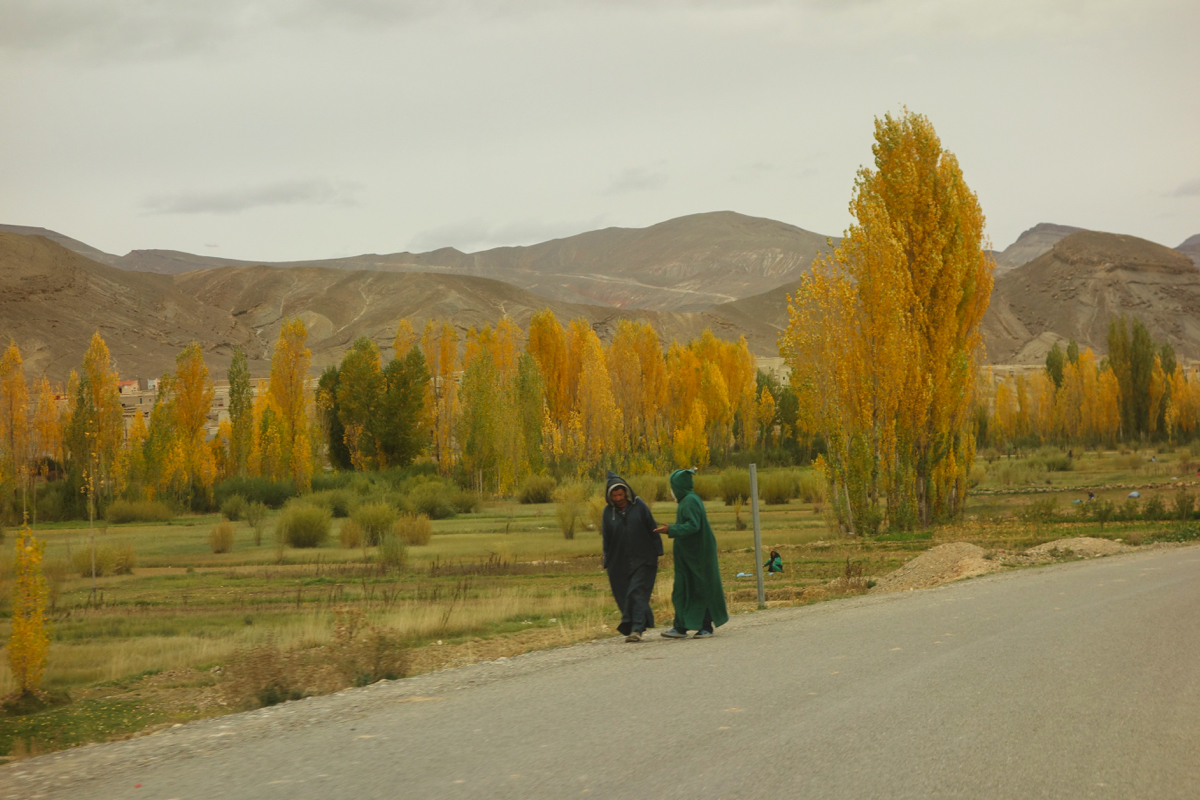
Men in djellabas stroll along the road. And it’s autumn in Morocco too.

Men in djellabas stroll along the road. And it’s autumn in Morocco too.

I really wanted to find a hotel as quickly as possible. We drove to the nearest somewhat larger town, which turned out to be Imilchil. There were 2 signs for hotels here, so we followed them. The first hotel turned out to be a private house where, on the top third floor, an enterprising Moroccan had made a couple of rooms into a hotel. The rooms turned out nice, but he wanted 50 euros, which was very expensive.

We drove to the second sign. It turned out to be an imposing building, looking like a real hotel. A very friendly Moroccan came out to meet us and took us to see the room. The room was quite decent and cost 20 euros, so we agreed. We checked in and went to the town center to eat.

We sat outside at a table in a dubious-looking snack bar, with no menu. The owner promised to make some kind of tagine and tea. The tagine turned out to be small meatball-like things in a tomato and onion sauce. It was tasty, and most importantly, it was hot food! We ate and watched the life of the town.

The town turned out to be very colorful. All the men here wore djellabas. And Wolf says, I’d like one like that too.

After dinner we went for a walk along the town’s only paved main street. At the very end of the street we found a little shop, with a dim light burning inside. But on closer inspection we saw a djellaba hanging inside. We went in. There was no one in the shop. And then apparently the shopkeeper appeared. The other djellabas were lying right on the floor, piled up in a heap mixed with carpets.

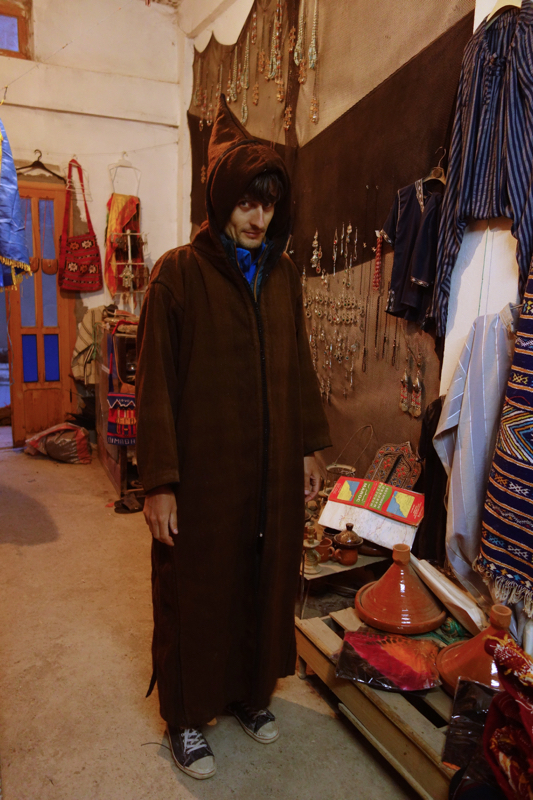
We found one very cool one, dark brown, thick, and just the right length for Wolf. I really wanted Wolf to try it on. So he put it on as a joke.

Wolf trying on a djellaba

Wolf trying on a djellaba

I don’t even know which one of us first came up with the idea of buying a djellaba. We had both been thinking about it for a long time (silently, each to ourselves), and now it had finally become reality, and so unexpectedly too. We asked the seller how much the djellaba cost, and he said 1,500 dirhams ($150!), without even blinking.

In shock, Volchy and I exchanged glances. I said, “He’s crazy, it can’t cost that much! What do you think its real price is?” Volchy said, “Well, probably I’d buy it for 300 dirhams ($30)”

And the old man kept talking about what a wonderful djellaba it was, that it was made of camel wool and that’s why it was so expensive.
Meanwhile Volchy takes 300 dirhams out of his wallet and says, here, I’ll buy it from you for this much. The seller can’t believe his eyes. 300??? - he laughs - no, no, that’s impossible! I’ll sell it to you for 1000, and only for you!

“Well, fine,” we say, and put the djellaba in the pile, getting ready to leave. The seller stops us - “all right then, let’s say 700!” Then he agreed to 500. He says - 500, final price. Volchy and I thought about it. And I said, “why do you even need it, this djellaba? Especially for 500 dirhams.” “Yeah, really, why do I need it,” Volchy agreed.

We were already almost out of the shop when the seller caught up with us and grabbed Volchy by the hand. He muttered under his breath, “All right, take it for 300.”

Volchy grabs the djellaba and says jokingly, “Let’s get out of here quickly, the seller’s really angry now.”

We walk off with the djellaba under our arm, laughing. “And where are you going to wear it?” I ask. “I don’t know, but it’s so cool.”

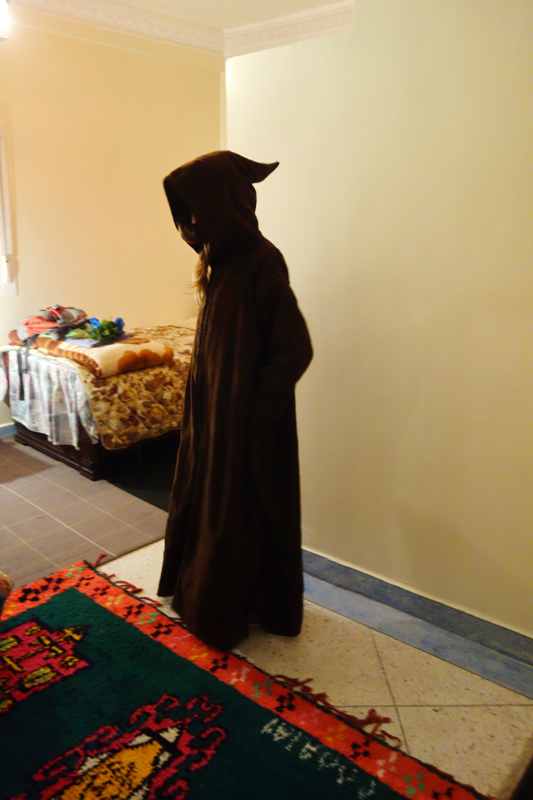
And in the room, where it was very cold again, we realized that it was also very warm!

I’m pacing around the room in a djellaba

I’m pacing around the room in a djellaba